Modern Methods of Training in Chess - Part 1
Examining New Methods for Training Chess Players
Modern Methods of Training in ChessPart 1
by GM Irina Mikhailova, TrainerT.V. Petrosian Chess Club (Moscow)
Page 1 2
The Formula for Chess Success: ELO 2200 + 2 years of training = International Master!
According to the patriarch of Soviet chess, Mikhail Botvinnik, four basic principles that form a chess player's strength are chess talent, a strong character, health and special preparation. However, in recent times some new methods for training chess players has emerged. These are identified by the extensive use of personal computers and chess software. Sadly, exploiting software and other computer resources for the purposes of chess training is rarely explained.
Some brilliant results have been achieved in a children's chess club named after T. Petrosian in Moscow where I recently worked for six years implementing computers in training. I would like to share some examples and considerations from this training.
The special preparation of young chess players is being modified nowadays due to additional opportunities that could not be realized previously due to technological restrictions.
- First, an exceptionally powerful tool has appeared in the chess players' toolkit, the personal computer. It accomplishes many functions such as collecting, systematizing and storing various chess data (games, fragments, positions for analysis), as well as tactical analysis of selected positions of a highest quality.
- Second, the intensity of the exercises in the training and control tests that require solving has been increased.
- Third, the method of presenting training material is also broadened; its structural organization has been deepened in level of complicity and thematic orientation.
Due to my experience I have come to the conclusion that acquiring an IM norm can be a realistic task for many pupils even in their school years.
Computers are a most a creative tool and can drastically increase the intensity of the training process. However, working with a computer is not as simple a task as it might first appear. Therefore the active role and responsibility of a trainer now includes implementing the new study course, since it is the trainer who plans and organizes all the stages of the training process.
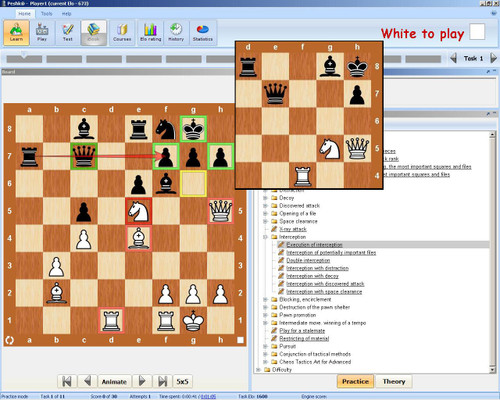
Obviously, chess software is the most important component. Happily, the club enjoys a long-standing business relationship with one of the world's best chess software manufacturers - Convekta Ltd. The training process in a club involves taking into account the individual learning requirements of each pupil. Usually only 3 - 4 players study in a class simultaneously.
Now I will dwell in detail on a training plan designed for young chess players who wish to attain an IM norm. When starting a battle for this high title a chess player must realize that this road is long and thorny. From the very start the stages must be well defined and set, as well as the means of achieving the final and the intermediate aims. Only the correct definition of all the aims and tasks will allow successful progress over the various stages.
Chess Training and Trials: "Base Line" before the Initial ELO Rating (2200) is Achieved
The very initial stage we call conditionally our "base line". The aim at this stage is to acquire a playing skill of approximately 2200 ELO. At this stage a chess player must have a successfully tested opening repertoire which includes 2 openings as White and 2 openings with the black pieces. The chess player must master tactics (60-70 per cent of a success rate solving problems of an intermediate difficulty), acquire a firm knowledge of the basics of chess strategy, ie. How a position's evaluation is developed and what are its components, familiarize with about 15-25 common plans from the chess classic examples, know typical chess endings: evaluation, plan of play and standard tactical methods for approximately 250 endgame positions. It is necessary to acquire the skills of working with a computer and with chess software.
The training process is organized in accordance with school workload and physical condition of the pupils, each one has an individual schedule.
A series of competitions and training games is designed to facilitate better assimilation of what has been learned.
After having achieved their "base line", the players start a 2-year training course aimed at them achieving an IM title. It is at this point that a clear record is set up regarding any relevant characteristics of each chess player. In order to improve the quality of the training process, a plan is drawn up which in our practice looks like this:
- A trainer, together with pupil develops an individual diary for the training schedule. Here the immediate and long term aims are set
- Using the pupil's diary, I develop a flexible schedule of individual training sessions and consultations. The unique chess software from Convekta Ltd offers an exciting range of activity for the players as well as being able to reveal each pupil's creative potential.
Since skilled chess players encounter various problems in all phases of the chess game - opening, middlegame and endgame, the program includes three parts:
- The preparative stage - acquiring the necessary skills and techniques to independently work with the database search system of Chess Assistant;
- Learning and mastering certain parts of chess theory (chess tactics and combinations, vitally important methods of play in the endings using examples from creative studies, theory and practice of playing particular openings). Here studying the corresponding sections of chess theory based on the creative experience of particular players (A. Alekhine, M. Tal and others) is also included. All of this can be done by using the appropriate chess programs;
- Training with playing programs aimed at mastering the acquired knowledge.
Page 1 2
|