Chess Notation
Keeping Score with
Algebraic Chess Notation
by Chess Instructor Dan Heisman
Keeping score with algebraic chess notation is easy! Here is a
tutorial on how to keep chess notation. Most 7-year olds can
do it, and it is required (if you know how) in US Chess Federation (USCF)
tournaments. You can buy a scorebook $3 a piece to keep track of 50 of your games (or just use a blank page).
Advantages of scorekeeping: 1) Replay your games to show better players and
learn from your mistakes, 2) Re-set positions after illegal move sequences, 3)
Prove who is to move and what the position is, and 4) Claim three-fold
repetition and many other rules that require scoresheet proof.- - - To keep
score:
1.Each line of squares going up and down the board is called a “file”. For
example, at the start of the game, both Kings are on the same file. Files are
lettered with small letters: a, b, c, d, e, f, g, h. No matter what color
you play, the “a” file is always on White’s left and Black’s right! The
Kings are on the “e-file.”

2.Each line of squares going left to right across the board is called a “rank”. For
example, at the start of the game, all your pawns are on the same rank. Ranks
are numbered 1, 2, 3, 4, 5, 6, 7, 8. The first rank is always where White
sets up his major pieces; the eighth rank is where Black sets up his major
pieces. No matter what color you play, the rank in front of Black is always
#8!
3.Each square is identified by its file and rank. So at the start of a
game White sets up his King on e1 and Black sets up his King on e8.
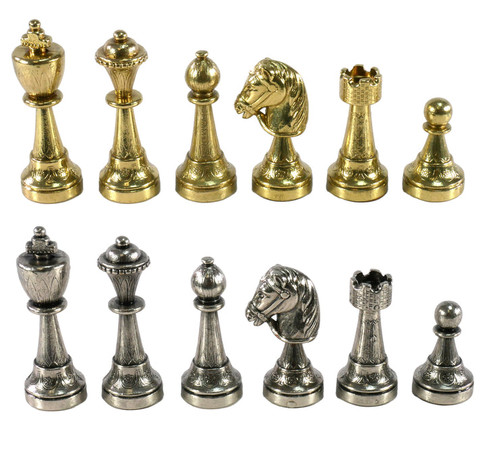
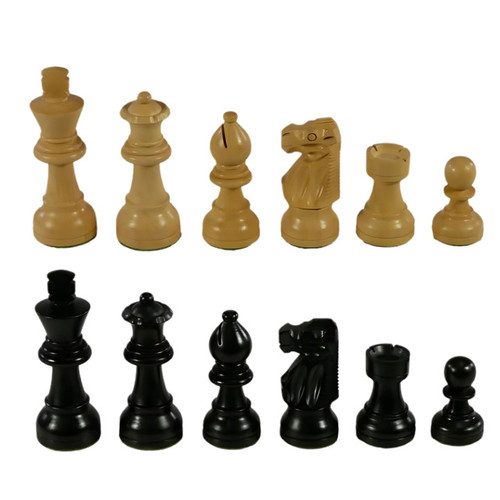
4.Each piece has a capital letter associated with its name. The King = K;
Knight = N; Queen = Q; Rook = R; Bishop = B. There are so many pawns that no
letter is used for a pawn (see example in #5 below).
5.Every time you move, you write the letter for the piece that moved followed
by the name of the square it moved to. For example, Ke2 or Qh5 or Bh8 or Nf6.
No dashes; it’s that easy. For pawn moves you don’t write the “p”, just the
destination square: e4, e5, h8. Remember: Capital letters are pieces, small
letters files
6.If more than one piece of the type that moved can move to the same
destination square, put the name of the rank or file where the piece came from
after the piece name to make the move unique: Rae1 or N8d7.
7.When you capture with a piece, put an “x” between the name of the piece and
capture square: Kxe2, Qxh5.
8.When you capture something with a pawn, instead of putting the name of the
piece on the left, you put the file (not the square) it came from, then the x
and the square on which it captured. For example: dxe5 or hxg6.Pawn captures
are the most commonly misused part of keeping score, so practice this correctly.
9.When a pawn reaches the final rank, indicate the square and the promoted
piece: a8Q, c1N
10.When you castle, you write O-O for kingside, O-O-O Queenside (the number
"O's is equal to the number of squares the Rook moved!)
11.A check is indicated by a plus at the end of the move: Rh8+ or Qxe2+.Mate
can be “#” or “mate”
12.When using a blank page, write the move numbers first down the left side
of the page (column form). Black’s moves are written to the right of White’s.
Remember, both players have a first move. Each player writes down all the moves
for him and his opponent. Both players should be writing the exact same thing,
since the first rank is always in front of White and the eighth in front of
Black. To best learn, keep score for 10+ games (half White and Black) over a
short period of time. Tip: Write your move before you play it!
A sample famous game: 1. e4 e5 2. Nf3 d6 3. d4 Bg4 4. dxe5 Bxf3 5. Qxf3 dxe5
6. Bc4 Nf6 7. Qb3 Qe7 8. Nc3 c6 9. Bg5 b5 10. Nxb5 cxb5 11. Bxb5+ Nbd7 12. O-O-O
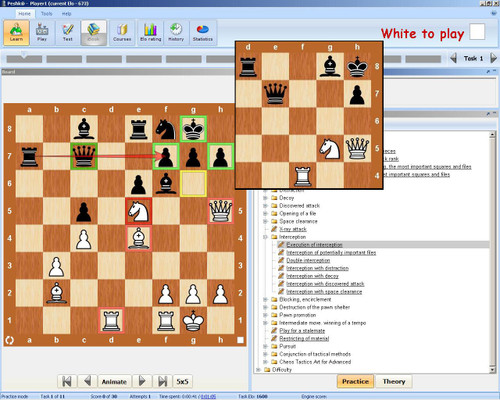
Rd8 13. Rxd7 Rxd7 14. Rd1 Qe6 15. Bxd7+ Nxd7 (see the diagram above for this
position!) 16. Qb8+!! Nxb8 17. Rd8#.This is not in column form due to lack of
space.
National Master Dan Heisman is a highly acclaimed Chess Instructor and best
selling chess author. You can get more terrific information about chess at
Dan's
Chess Page
Thank you for visiting our chess notation page. If you would like to make
a comment on the information on chess notation, please email us at
email@chesscentral.com.
|